
OPAL
Olmsted Partnership for Assistance and Lifelines
Simplifying shelter access for people in urgent need of shelter.
What is OPAL?
OPAL is a digital housing space reservation system developed in collaboration with the Zumbro Valley Medical Society. It simplifies shelter access for people experiencing homelessness by allowing them to reserve a bed through a low-barrier, easy-to-use digital check-in process. By filling out a short form with just four basic details, guests receive a digital token that confirms their spot for the night. This token allows them to arrive directly at the shelter, show their ID, and settle in quickly—no waiting outside in harsh weather, no paper lists, no confusion.
FAQs
-
For too long, shelters and outreach teams have relied on paper logs, word-of-mouth updates, and manual coordination to track who needs a bed and who gets one. That system left too many people behind. OPAL was born from the urgent need to reduce barriers, give guests dignity, and provide frontline staff with tools they actually want to use. By digitizing and simplifying shelter access, OPAL ensures that no one has to face the cold without a plan.
-
Guests benefit from a streamlined process: a simple form, a digital token, and the reassurance of a reserved bed. Shelter staff gain an intuitive dashboard to manage capacity, assign beds, track overflow spaces, and accommodate mobility or preference needs. Additionally, a portion of beds is reserved for walk-in guests, keeping accessibility at the forefront. By making the system simple and reliable, both guests and staff spend less time navigating confusion and more time focusing on care and support.
-
OPAL aims to transform shelter access into a system that is equitable, coordinated, and human-centered. Guests can check in quickly and with dignity. Staff spend less time on paperwork and more time helping people. Communities gain better insight into real-time needs, ensuring resources reach those who need them most.
-
Since launching the project, OPAL has completed in-depth research with shelter administrators and staff, designed wireframes and user flows based on real-life shelter operations, built the first MVP, and tested it with partners. Feedback has been incorporated to make the system even simpler. The team is now finalizing a version ready for deployment this winter.
-
We are exploring opportunities to expand OPAL beyond Rochester through new partnerships and research collaborations.
PathCheck Foundation is in early discussions with the Bloomberg Center for Cities at Harvard University, the City of Cleveland, and New York City to explore how OPAL’s model could be adapted and scaled to meet housing and shelter coordination needs in other urban settings.
These conversations represent the next phase of OPAL’s growth, focused on applying data-informed and privacy-centered approaches to address homelessness more effectively across diverse communities.
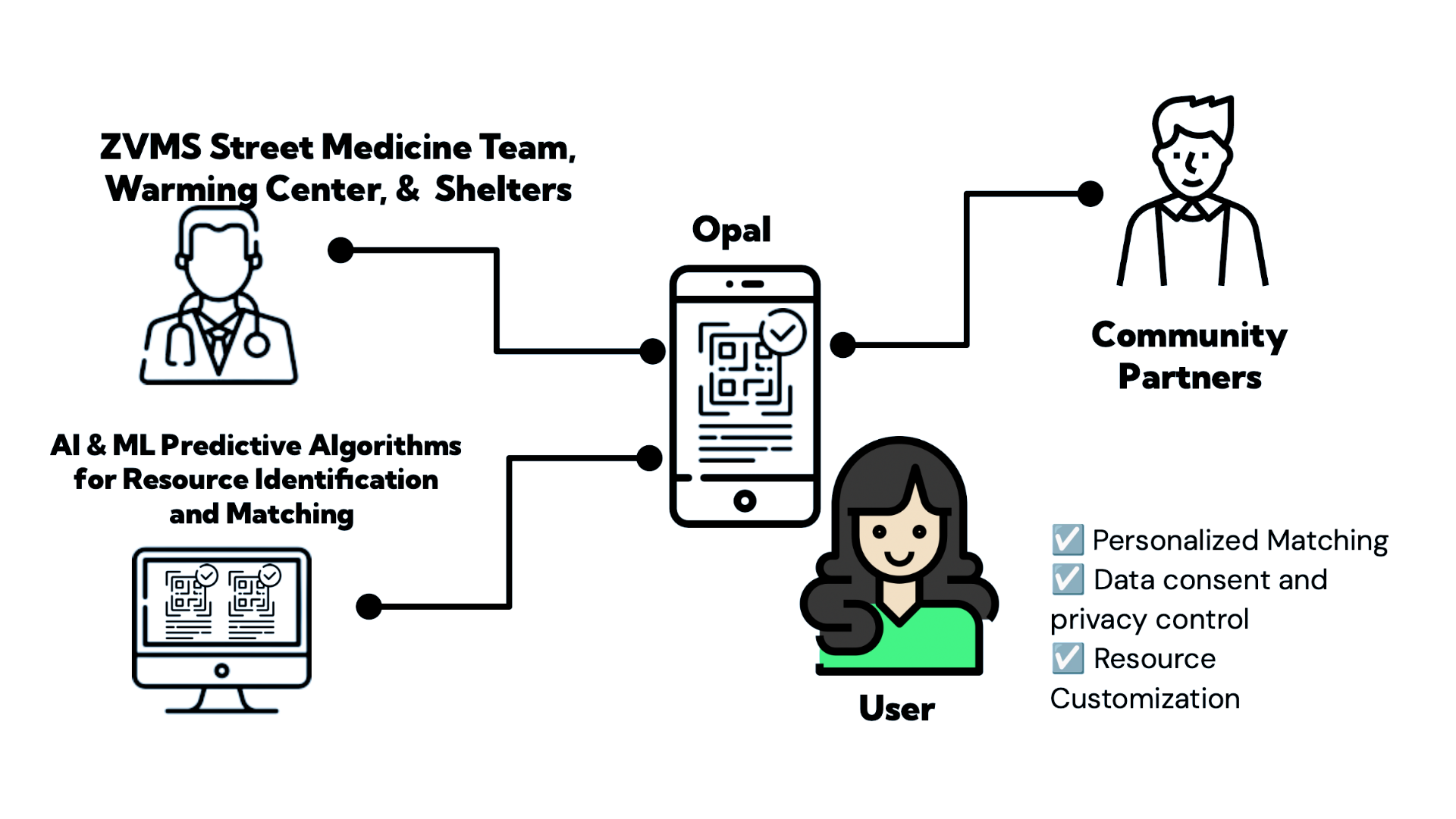
OPAL Framework
Project Roadmap: The Evolution of the OPAL Platform
Our commitment to supporting vulnerable populations and the staff who serve them is an ongoing journey. Below is our strategic Statement of Work, detailing how we plan to enhance, pilot, and eventually scale the OPAL platform from a local warming center solution to a national, AI-driven resource.
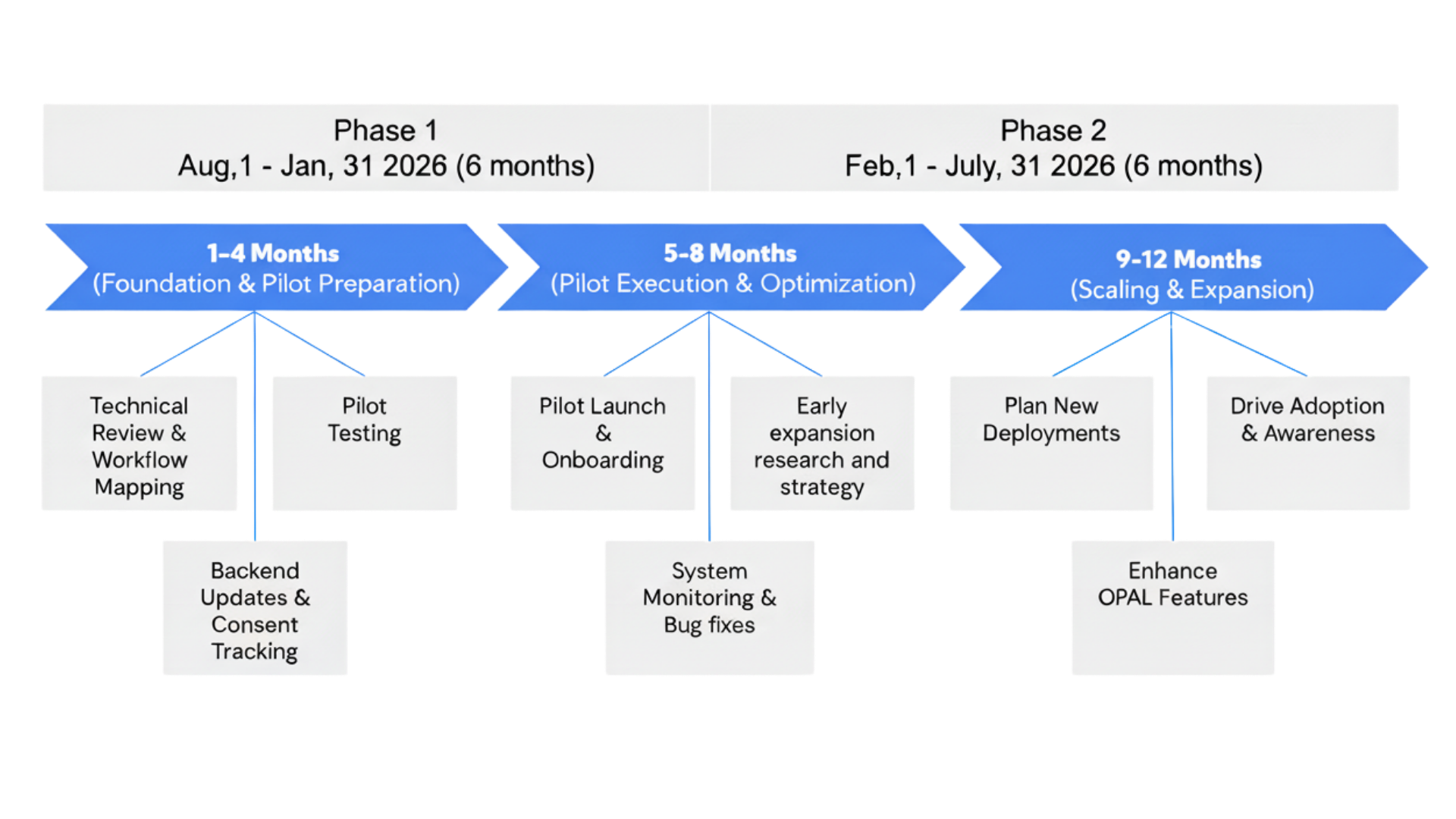
Phase 1: Platform enhancement & pilot Support
Duration: August 1, 2025 – January 31, 2026
Goal: Establish a strong, user-friendly foundation and ensure operational readiness for the critical winter months.
During this initial six-month phase, our focus is squarely on the ground level: improving the user experience, building essential tools for staff, and rigorously testing the platform in a real-world environment.
Key Objectives:
Inclusive & dignified user experience (UX): We are overhauling the platform's language and intake flow to promote clarity and inclusion.
Essential tools for staff coordination: To empower those running the facilities, we are introducing manual bed tracking capabilities and basic reporting tools. We are also adding custom data fields specifically tailored to support pilot staff, ensuring they have the exact information they need to coordinate effectively.
Comprehensive onboarding: Technology is only as good as the people using it. We will provide hands-on support and training to warm center staff and partner organizations to ensure a smooth transition during the early rollout.
Real-world pilot & winter readiness: The true test of OPAL will be at the Warming Center. We will run an active pilot, aggressively gather user and staff feedback, and rapidly fix any bugs. Our primary deadline is ensuring the platform is fully stabilized and optimized for the peak winter season.
Phase 2: Scaling and strategic expansion of OPAL (Tentative)
Duration: February 1, 2026 – July 31, 2026
Goal: Leverage pilot data to optimize the platform, research broader adoption, and finalize a multi-year roadmap for national expansion.
Phase 2 shifts the focus from immediate pilot support to long-term, strategic growth. We will use the lessons learned in Phase 1 to build a more robust system capable of handling thousands of users across the country.
Strategic plan development:
A major component of Phase 2 is finalizing the strategic blueprint for OPAL's future. This expansion will be guided by three core pillars:
1. Feature Expansion (Driven by Data)
We will expand the platform’s functionality based not on guesswork, but on actual market demand, comprehensive research, and feedback gathered during the Phase 1 pilot.
2. Technological Architecture Evolution
We are planning a phased technological upgrade to move from manual operations to advanced, predictive automation:
Phase 2: Manual input and basic tracking.
Year 2: Implementation of rule-based algorithms to automate standard processes and matching.
Year 3: Integration of Machine Learning (ML) predictive modeling and Artificial Intelligence (AI) to anticipate shelter needs and optimize resource allocation.
3. Geographic Scaling
We have a clear, step-by-step plan to expand our reach safely and effectively:
Phase 2: Rollout to 15-20 specific ZVMS warming centers.
Year 2: Expansion across Rochester community sites, scaling up to support a maximum of 1,000 active users.
Year 3: Full national expansion of the platform.
Continuous improvement & adoption strategies:
Alongside long-term planning, Phase 2 includes immediate actions to improve the current platform and prepare for new users:
Platform refinement: We will significantly improve system performance and upgrade reporting tools based directly on the feedback gathered from Phase 1 pilot users.
User research: We will initiate deeper user research to understand the diverse needs of different communities, exploring strategies to drive broader adoption of OPAL.
Deployment toolkits: To ensure smooth scaling in Years 2 and 3, we will develop comprehensive early onboarding guides and communication materials. This ensures that when new organizations adopt OPAL, they have the resources they need to succeed from day one.
Project Timeline
Meet the Team
-

Eva Sundberg
-

Sepehr Safari
-

Jugjyoti Borgohain
-

Cirila Cerilo
Collaborators
-

Beth Kangas
Medical Anthropologist , Executive Director ZVMS Foundation.
-

Collin Johnson
Leadership at The TABLE
Advisory team
-

Tristan McAllister
FOUNDER & MANAGING DIRECTOR at Atlarge Consult
-

Khahlil Louisy
Executive Director at The PII
Client


Project Core



Advisory